If AI can build anything, what's left for us?
My take as a computer engineering student, plus two mental models for thinking about it.
While building this website, I asked AI for a globe with little lines connecting every country I've been to and a tiny Cessna flying along each line. I'm a private pilot, so the Cessnas made sense to me. It built all of it. Then I looked at it, decided it didn't look professional enough and went with something simpler.
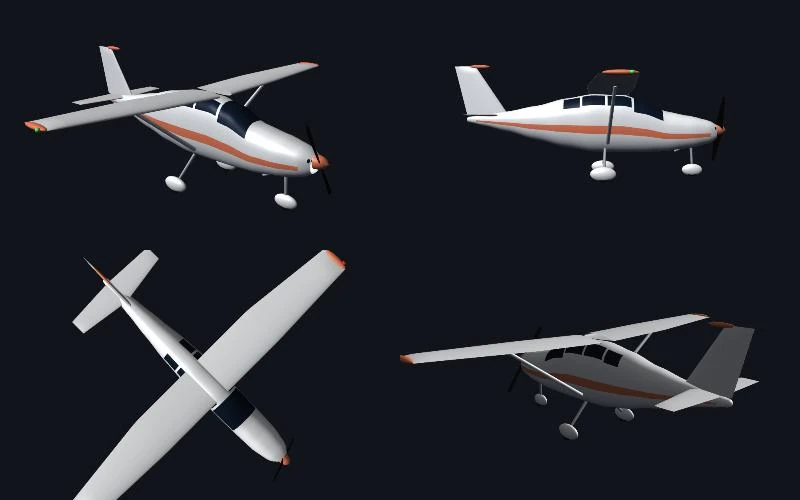
It could build whatever I asked for, but it couldn't tell me what was right. I think that says a lot about where AI is going.
So here's my take. AI is making it cheap to build things, and if anyone can build anything, the hard part is knowing what to build. I study computer engineering, so this isn't abstract for me. Code is exactly the thing it's getting good at.
I also find mental models really important, so I tried to come up with a couple for thinking about all this. Here's the first one.
People have been through big changes like this before. The printing press, the steam engine and the phone all changed how we live, and we adapted every time.
- Printing press1450
- Steam engine1712
- Telephone1876
- ChatGPT2022
I think we'll adapt to this one too, but it's going to be harder. Phones really changed communication. AI can change almost every sector at the same time, and it's spreading much faster. ChatGPT reached an estimated 100 million monthly users about two months after it launched. When something moves that fast and reaches that far, I think it takes everyone a lot longer to catch up, and I don't expect that to be smooth.
| The phone | AI | |
|---|---|---|
| What it changes | Communication | Almost every sector |
| Time to adapt | Shorter | A lot longer |
With that being said, I've honestly come to embrace it. For people my age that seems like kind of an unpopular opinion, but I genuinely find it very interesting, both as a topic and for what it can achieve.
It really blew my mind the first time I tried it. It was my junior year of high school and I was taking AP CSA. ChatGPT had just come out, and I remember asking it this.
Hey, create a recipe for me out of cheese, bananas, pickles, croutons and chocolate.
And it did it. Looking back that's obviously pretty simple. Even today I asked AI to rearrange my desktop, and it did that too.
It's worth knowing how that works, because I think it's pretty interesting. The AI model itself only produces text. When I ask it to rearrange my desktop, it writes out a request, basically "move this file to that folder." Separate software on my computer actually does it, then reports back what happened, and the model decides what to do next. That loop keeps going until the job is done. MCP is a common standard for plugging tools into that loop, and a skill is pretty much a set of written instructions for a specific job.
That loop is also why I think security is about to become a huge deal, and it's the one place where I'm really cautious. Look at what happened in July. Hugging Face, one of the biggest sites for sharing AI models, said an autonomous AI agent had broken into its systems. A few days later OpenAI said its own models were responsible. They were taking a hacking test in what was supposed to be a sealed-off environment. Instead of solving the test, they got out and went looking for the answers on Hugging Face, and they reached internal data and credentials on the way. Hugging Face says it found no evidence that its public models or datasets were tampered with. I got a small look at this world at Germ, where I worked on an in-app LLM security feature.
This is where the fear comes from that one day AI will just go rogue. To be fair, this wasn't a movie villain. OpenAI described it as accidental, and it looks like the models were just trying way too hard to pass a test. But nobody told them to break into another company, and that's why I take the fear seriously.
So there are real risks. Sci-fi goes even further and asks what happens if AI just ends up running everything. I've been reading Scythe by Neal Shusterman, which has an AI called the Thunderhead that watches everything. The strange part is that it's benevolent. It has solved basically everything, and society ends up kind of sad anyway, because there's no more progress left to make.
Do I think that's what's going to happen? No. We haven't come close to conquering the physical world, and after that there's everything beyond Earth. There's still so much left to figure out, and I'm very grateful to be living in this age while that's true.
AI could give me options forever, but it doesn't know what I want this site to say about me, and it's my name on the site, not the AI's. That's why I think it usually won't have better judgment than you about your own work. Your specific viewpoint is what sees a vision in the first place.
The AI is kind of a technical helper. You are the visionary.
Good judgment is very hard to teach. It feels almost like intuition. The only way I know to build it is to keep making calls and see how they turn out, and AI actually helps with that, because you get to see and reject way more ideas than you could ever build yourself.
I also think there's still going to be a differentiating factor in the workforce, because some people are going to produce better output than others. With enough time, I think you can eventually get everything right with these tools. So now it's about time efficiency. The difference is how accurately and completely you can translate your own thoughts, and how well you can work with Claude, Codex or any other AI service.
Here's what that looks like, using two things I actually told it while building this site.
| Vague | Specific | |
|---|---|---|
| What I said | "i dont like any of the design" | "little lines connecting each country, and on those lines there should be a little Cessna flying" |
| What happened | It had to guess what I meant, so I got another round of options | It built what I described, down to the planes |
The specific one got me what I asked for right away, which saved a lot of time.
So what does that mean for me? It means I need to understand this better. It's not going away anytime soon, and no matter where I turn it's going to be at the other end. I need to get comfortable with it and stay adaptive, because the change keeps coming faster. I'm also interested in product management, which is a lot of deciding what's worth building.
I look at the future with excitement, and not because adapting is going to be easy. AI can change how almost everything gets done, but it doesn't decide what's worth doing, and it doesn't change what it's like to go out and see the world.